Blocked Nose in Newborns: What Causes It, Safe Home Remedies, and When to Worry
If your newborn sounds like a tiny, congested little snuffler, you are not alone. Nasal congestion is one of the most common concerns new parents bring to their pediatrician in the first weeks of life — and in the vast majority of cases, it is completely harmless. But because newborns are obligate nose-breathers (meaning they breathe almost exclusively through their nose for the first few months of life), even mild congestion can interfere with feeding and sleep and cause significant parental anxiety.
This guide explains why newborns get congested so often, what you can safely do about it at home, what you should never do, and the specific signs that warrant a call to your doctor.
Why Newborns Get Congested So Easily
There are several reasons newborn noses block up so readily, and most of them are to do with anatomy and biology rather than illness.
Small nasal passages
A newborn's nasal passages are very narrow — about the diameter of a pencil. Even a small amount of mucus, dried secretion, or tissue swelling is enough to partially obstruct airflow and create the snuffling sound that worries parents. This does not mean your baby has a cold.
Physiological congestion
In the first few weeks after birth, many newborns experience what is called physiological congestion — congestion caused simply by the transition from the fluid-filled womb to the air-filled world. The nasal passages, previously bathed in amniotic fluid, are adjusting to breathing air. This usually resolves on its own within the first month and requires no treatment.
Dry air
Low humidity dries the mucous membranes lining the nasal passages. In air-conditioned environments — which are common across India, particularly in cities — the air can become very dry, causing nasal secretions to thicken and form crusts that partially block the passages. This is one of the most common causes of persistent mild congestion in otherwise healthy babies.
Milk in nasal passages
During feeding, particularly with a strong let-down reflex, small amounts of milk can enter the nasal passages. This causes temporary congestion that usually clears within a few minutes.
Safe Home Remedies That Actually Work
Saline nasal drops
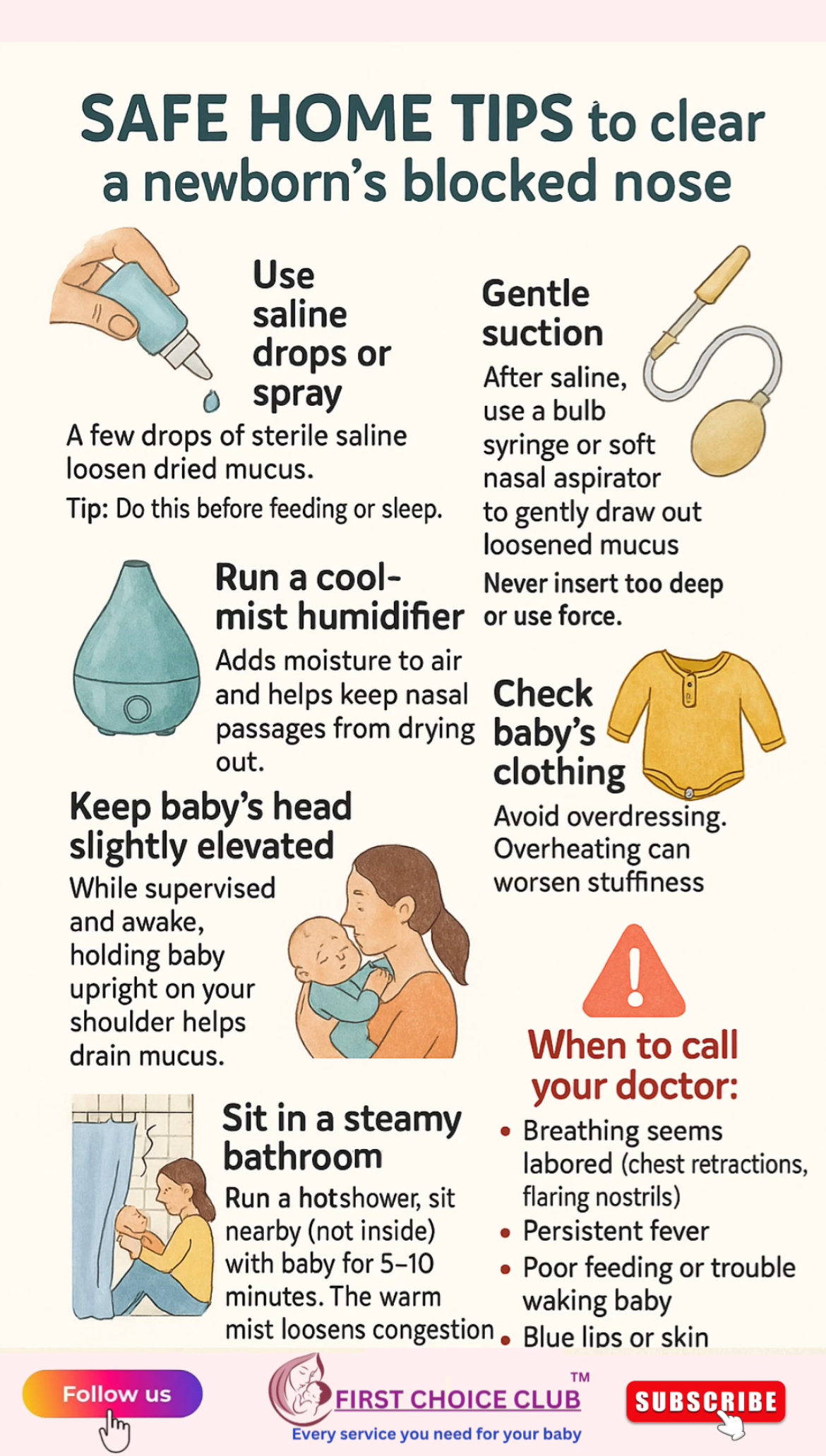
Sterile saline nasal drops are the single most effective and safest treatment for newborn nasal congestion. They work by softening and loosening dried mucus, making it easier to clear. Use two to three drops in each nostril, let it work for about 30 seconds, and then use gentle suction to remove the loosened secretions. Saline drops can be used before every feed and before sleep. They are available at every pharmacy in India without prescription and are completely safe for newborns from birth.
Important: use only sterile saline drops specifically formulated for infants. Do not use adult nasal sprays, decongestant sprays, or saline sprays with preservatives on a newborn.
Gentle nasal suction
After applying saline drops, a rubber bulb syringe or a dedicated nasal aspirator removes loosened mucus from the nostrils. Squeeze the bulb before inserting it gently just inside the nostril, then release slowly to create gentle suction. Never insert the syringe tip deeply into the nostril, and never use a regular syringe or any device with a rigid tip. Limit suction to two or three times per nostril per session — too-frequent suctioning irritates the nasal lining and can worsen congestion.
Humidifier
A cool-mist humidifier in your baby's room adds moisture to the air, prevents nasal secretions from drying out and hardening, and reduces the frequency and severity of congestion episodes. Place the humidifier at a safe distance from the cot — at least one metre away — and clean it every day to prevent mould and bacteria from growing in the water reservoir. Do not use warm-mist humidifiers, which can cause burns if your baby gets close to them, and avoid adding menthol or eucalyptus products to the water.
Upright position
Gravity helps. Holding your baby upright on your shoulder or in a carrier after feeds allows mucus to drain more easily from the nasal passages. If your baby is congested at night, placing a thin, firm wedge under the head end of the cot mattress (not under your baby's head directly) can slightly elevate the sleeping position and reduce nighttime congestion. Never prop your baby with pillows or rolled blankets — these are serious SIDS hazards.
Steam
Sitting in a bathroom while you run a hot shower creates a warm, humid environment that can temporarily relieve congestion. Sit with your baby on your lap — not in the shower itself — for ten to fifteen minutes. Ensure the room is warm but not dangerously hot, and monitor your baby carefully throughout. The effect is temporary but can be particularly useful before bedtime feeds when congestion is interfering with feeding.
What You Must Never Use on a Congested Newborn
Congestion vs a Cold: How to Tell the Difference
Simple nasal congestion without other symptoms is rarely caused by a viral infection. A cold, by contrast, typically presents with a runny nose (often clear initially, then thickening to yellow or green over several days), sneezing, mild fever, reduced feeding, and increased fussiness. Most babies catch their first cold somewhere between six weeks and three months of age, usually from a family member.
A baby with a cold needs the same care as one with simple congestion — saline drops, gentle suction, humidification, and upright positioning — with additional attention to feeding and hydration. Fever in a baby under three months old (38°C or above) always requires same-day medical assessment regardless of the apparent cause.
When to Call Your Pediatrician
Most newborn congestion is benign and responds to simple home management. However, contact your doctor if your baby shows any of the following: a fever above 38°C, difficulty breathing (rapid breathing, visible effort, ribs showing, or noisy breathing beyond the normal snuffling), refusal to feed or feeding significantly less than usual for more than one feed, blue or grey colour around the lips or fingertips, or congestion that has persisted for more than ten days without any improvement.
Trust your instincts. If something about your baby's breathing feels wrong, get it assessed. You are not overreacting by calling your pediatrician. Finding a trusted pediatrician before your baby needs one is something every new parent should do — visit firstchoiceclub.in to find verified pediatricians across India and globally.
29 Jul