When Your Baby Won't Burp: Why It Happens and Every Technique That Actually Works
The burp. It seems like it should be the simplest thing in the world — feed your baby, pat their back, they burp, everyone moves on. But any experienced parent will tell you that some nights, no matter how long you pat, how many positions you try, or how carefully you were with the feed, the burp simply refuses to come. Your baby squirms, pulls their legs up, fusses, and you sit in the dark at midnight wondering what you are doing wrong.
You are not doing anything wrong. Burping is genuinely variable between babies and between feeds. This guide explains why some babies swallow more air than others, why some feeds produce more gas, every burping position and technique that works, and when it is actually okay to simply give up and put your baby down.
Why Babies Need to Burp at All
When babies feed — whether from the breast or a bottle — they inevitably swallow some air along with the milk. This swallowed air collects in the stomach and, if it is not released, moves into the intestines where it causes the cramping, bloating, and discomfort that most people call gas or wind. In the stomach, trapped air creates a sensation of fullness that can make a baby seem unsettled and hungry again shortly after a feed even when they have taken enough milk.
Burping releases the swallowed air from the stomach before it has a chance to move downward. It is particularly important in the first three to four months of life, when babies have not yet developed the digestive tract motility to move gas through easily on their own.
Why Some Babies Are Harder to Burp Than Others
Feeding method
Breastfed babies typically swallow less air than bottle-fed babies, particularly when the milk flow is well-regulated and the latch is good. A strong let-down reflex can cause a breastfed baby to gulp and swallow air, but generally breastfed babies need less burping than formula-fed babies. Formula-fed babies, especially those using fast-flow teats, swallow significantly more air with each feed and usually need to be burped more deliberately.
Teat flow rate
If you are bottle feeding and finding that your baby is consistently gassy and difficult to burp, the teat flow rate may be too fast. A teat that delivers milk faster than your baby can swallow forces them to gulp, swallowing significant amounts of air in the process. Try switching to a slow-flow teat and see if the situation improves over two to three feeds. This single change resolves persistent wind and burping difficulty in many babies.
Feeding position
How a baby is positioned during a feed significantly affects how much air they swallow. A baby who is feeding in a very reclined position (nearly horizontal) tends to swallow more air than one who is feeding in a more upright position. For bottle-fed babies, holding the baby at approximately a 45-degree angle and keeping the teat full of milk (paced bottle feeding) reduces air intake considerably.
Some babies simply produce less gas
Just as adults vary in how much they burp and pass gas, babies vary too. Some babies barely need burping at all — they swallow minimal air, have relaxed lower oesophageal sphincters that allow gas to escape naturally, and rarely seem gassy. Others are the opposite. Both ends of the spectrum can be entirely normal.
The Three Classic Burping Positions
Over the shoulder
This is the most commonly used position and works well for most babies. Hold your baby upright with their chin resting on your shoulder, their tummy pressed gently against your chest. Support their bottom with one hand and use the other to gently pat or rub their back in a slow, rhythmic motion. The gentle pressure of their tummy against your shoulder helps dislodge trapped air.
Sitting on your lap
Sit your baby on your knee facing outward or to the side. Support their chin and chest firmly with one hand — your fingers spread to support the chest, your thumb and forefinger forming a gentle V under the chin to keep the head up. Use your other hand to pat or rub the back. This position works well for babies who resist the over-the-shoulder position or for parents who find it awkward.
Face-down across your lap
Lay your baby tummy-down across both your knees, making sure their head is slightly higher than their chest and is well-supported. Gently pat or rub the back. The tummy-down position creates a different pressure dynamic and works particularly well for babies who have been difficult to burp in the upright positions.
What to Try When Nothing Is Working
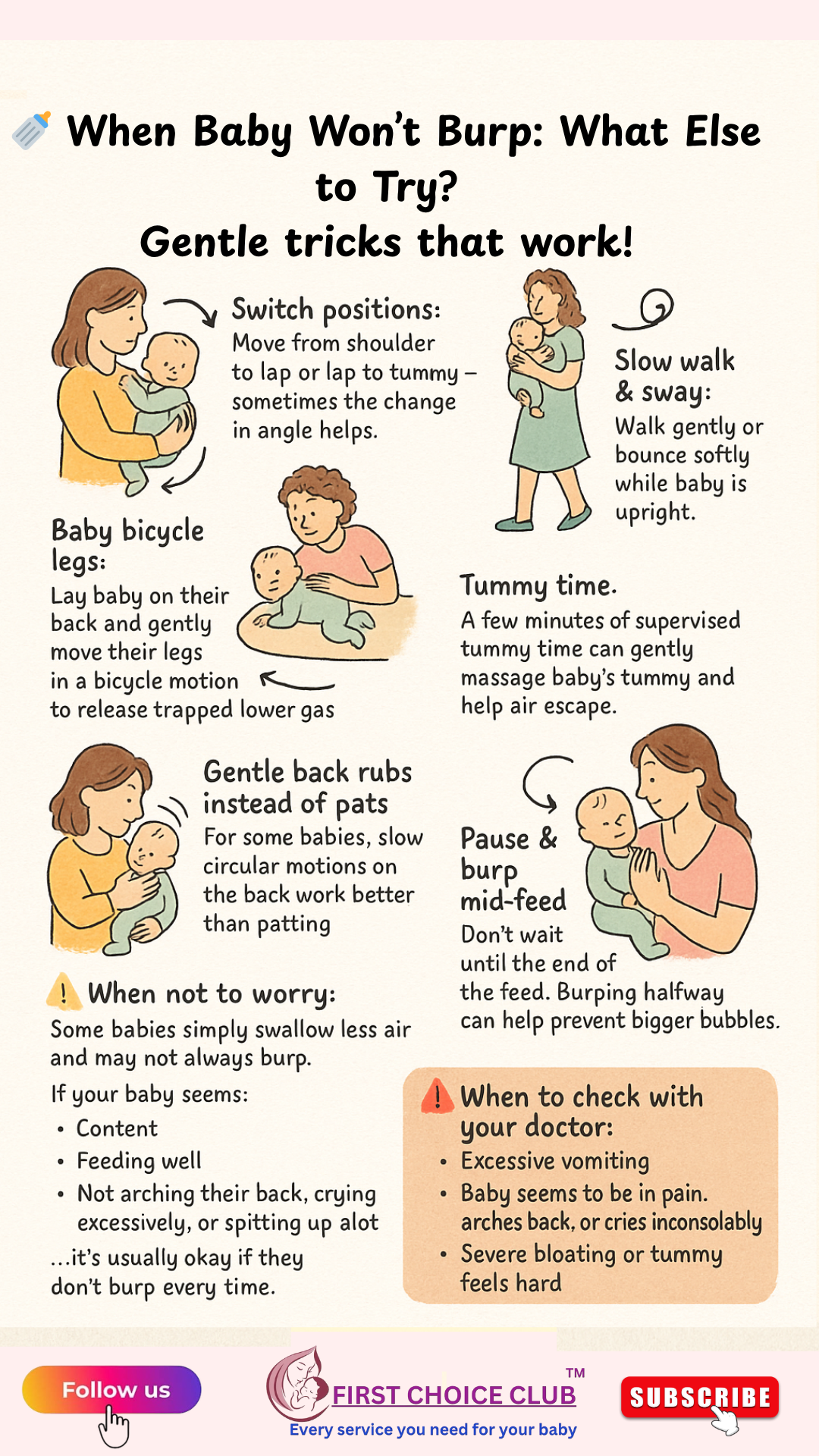
Change positions mid-attempt
If you have been trying one position for more than two minutes without success, switch. Moving from over-the-shoulder to sitting upright to face-down and back again shifts the air bubble within the stomach, often dislodging it in a way that staying in one position cannot.
Try gentle back-rubbing instead of patting
For many babies, slow circular rubbing of the back from the base of the spine upward is more effective than patting. The gentle upward pressure physically moves trapped air toward the oesophagus. Try this for a full minute before returning to patting.
Bicycle legs
Lay your baby on their back and gently move their legs in a cycling motion — alternating legs as if they are pedalling a slow bicycle. This movement stimulates the abdominal muscles and digestive tract, helping move gas both upward (to burp) and downward (to pass as wind). It is particularly effective for gas that has moved past the stomach into the intestines and is causing lower abdominal discomfort.
A brief pause and restart
Sometimes a baby who is tense and squirming because of trapped gas makes it harder for the gas to escape. Try stopping the burping attempt, giving your baby a minute of calm skin-to-skin or gentle rocking to relax them, and then trying again. A relaxed baby burps more easily than a distressed one.
Burp mid-feed, not just after
If your baby is consistently difficult to burp at the end of a feed, try burping partway through instead. For bottle-fed babies, pause at around the halfway point of the feed. For breastfed babies, burp when switching sides. Releasing air mid-feed prevents large air bubbles from accumulating and makes the after-feed burp much more manageable.
When Is It Okay to Give Up?
If you have spent five to ten minutes trying to burp your baby and nothing has worked, it is usually safe to put your baby down. A baby who settles comfortably after being placed in their sleep space — on their back, in a safe sleep environment — almost certainly does not have a significant amount of trapped air causing discomfort. Some feeds simply produce less gas than others, and not every feed will produce a burp.
However, a baby who cannot settle, who pulls their legs up, arches their back, and cries persistently after being put down is showing signs of genuine discomfort that warrants continuing your efforts. Try the bicycle legs technique in this position, give a gentle tummy massage in clockwise circles, or hold your baby upright for another ten minutes before trying to settle them again.
When to Mention It to Your Pediatrician
Occasional difficulty burping is entirely normal. However, speak to your pediatrician if your baby seems to be in significant pain during or after most feeds, if you notice your baby spitting up large volumes (not just small posseting) with most feeds, if your baby is not gaining weight well, or if the gas and discomfort seem to be genuinely affecting their quality of life and sleep. These may be signs of gastro-oesophageal reflux, which is common and treatable, or of a milk sensitivity that warrants investigation.
28 Jul